corish.dev · writing
Satire Substantive Essay
May 2021
PROLOGUE
ROUTE A: NIER: [A]UTOMATA
Scene I Gender as a performance.
Scene II Fear as a motivator.
Scene III Religion as an institution.
ROUTE B: THE STANLEY PARA[B]LE
Scene I Events as inevitabilities
Scene II Freedom as a choice
Scene III Choice as an illusion
ROUTE C: [C]ONCLUSION
Scene I Achievements as a pursuit
Scene II God is dead
Scene III Long Live God
EPILOGUE
PROLOGUE
The meaning of life is a question that has long been contemplated. For many in our present day, life has become a never-ending cycle of waking up, surviving, and returning to sleep. One may begin to question if existence has a purpose or if we even exist in the first place. We may contemplate whether we truly have free will, or whether our fate has been determined since birth. We may find meaning in God. The medium of computer games is wholly suited to satirising these contemplations. Nier: Automata is Juvenalian in its approach, whereas The Stanley Parable is Horatian. Both are unique in that they tell a story that could only be told within an interactive medium.
Everything that lives is designed to end. We are perpetually trapped in a never-ending spiral of life and death. Is this a curse? Or some kind of punishment? I often think about the god who blessed us with this cryptic puzzle… and wonder if we’ll ever get the chance to kill him. (Taro)
ROUTE A: NIER: [A]UTOMATA
Nier: Automata focuses on a proxy war between Androids and Machines set in the year 11945 AD. Following an alien invasion, humanity is forced to flee to the moon, leaving behind a force of elite androids to fight the alien’s army of machines. You play a YoRHA No. 2 Type B android (2B), accompanied by a scanner unit, 9S. The two begin their mission in earnest, destroying machine lifeforms in droves. However, they soon discover that the machines have been trying to mimic human society in attempts to find meaning. It is through these machines that the game bitterly condemns humanity’s vices. The machines are learning from and mimicking a failed society.
SCENE I: GENDER AS A PERFORMANCE
“One is not born, but rather becomes, a woman.” (Beauvoir, 301)
Simone de Beauvoir was a French writer and existentialist who posed many questions surrounding sex and gender. Her works have been crucial to establishing gender as the cultural meaning and form which your body acquires, as opposed to something decided by biology. Butler states, “To be a gender, whether man, woman, or otherwise, is to be engaged in an ongoing cultural interpretation of bodies.” (36) Womanhood and femininity are societal constructions imposed upon you. Beauvoir argues that the source of women’s oppression is society’s positioning of these constructions as the Other; the idea that women are different from men. This is key to society’s organisation into a patriarchy. Both femininity and masculinity are performances, but masculinity is forever treated as the default and a hierarchy is formed. Throughout history, satire has many times taken an anti-feminist slant. Finke notes the anonymous 1697 play, The Female Wits. “His purpose is not merely to attack one or two women dramatists but to condemn all women to a kind of silence, to suggest that literary creativity is itself alien to woman” (Finke, 64). We must accept that the attitudes displayed in The Female Wits have not entirely gone away and many today reproduce the misogyny of our forefathers; an attitude the machine lifeforms try to replicate.
In Nier: Automata, 2B and 9S infiltrate an amusement park and encounter a machine dressed as an opera singer; her body decorated by android corpses. She breaks into song and the fight begins. On the second playthrough, we learn that, at one point, the opera singer had fallen in love with another machine. The machine didn’t return her affections and thus, she concludes that to win his love, she must become beautiful. She studies the old world to learn what it means to be beautiful:
What is “beauty”? …
Beauty is pretty skin.
Beauty is stylish accessories.
Beauty is looking one’s best.
I will become beautiful. I will do it for him. (Taro)
The opera singer hears a rumour that devouring android corpses leads one to gain eternal beauty. She forces herself to feast on androids, making herself vomit from their oily taste. She devotes her existence to pursuing beauty, learning to sing and decorating herself with android corpses. When the machine still does not love her, she resorts to cannibalism and begins eating other machine lifeforms. Still, he does not look her way:
He won’t look my way. He won’t look my way. He won’t look my way. Won’t look my way won’t look my way won’t look my way won’t look my way won’t look my way won’t look my way won’t look my way won’t look my way won’t look my way won’t look my way won’t look my way won’t look my way won’t look my way … I gaze into the mirror. In its reflection I see only my own meaninglessness. And so, I scream. Someone, please look my way” (Taro)
The opera singer is engaging in what she believes to be a performance of femininity. Her understanding of the concept is twisted but this is how the machine lifeforms work as satire; taking human attitudes to their most extreme conclusion. During the boss fight, the opera singer begs the player to look at her; she is desperate for validation. However, the game wrests control of the camera away from the player; no matter what controls you input, you cannot position the camera such that it looks her way. Nobody will look her way.
This sequence satirises the notion of gender as a performance. It is deeply tragic, bitter, and ironic. The satire is Juvenalian as it is by no means funny or light-hearted. However, its overarching message could not differ more greatly from Juvenal’s work (Juvenal’s Satire 6 is a highly misogynistic piece in which women and their many flaws are discussed in great detail). Drag is a modern-day example of exposing gender as a performance that is more Horatian in outlook. The sequence also opens wider questions about gender. Androids and machines do not share our biology and yet, we gender them. We design plastic, metal, silicon, and computer code in our likeness. Likewise, we insist on building our own biases into AI assistants and the like. AI voice assistants intended to be helpful feature female-sounding voices, whereas we may build a male voice into a security system. There is no practical reason behind why the YoRHA androids are gendered, aside from humanity finding comfort in replicating the familiar.
SCENE II: FEAR AS A MOTIVATOR
Let us weigh the gain and the loss in wagering that God is. Let us estimate these two chances. If you gain, you gain all; if you lose, you lose nothing. Wager, then, without hesitation that He is. (Pascal, 418)
Blaise Pascal was a French philosopher known for his masterpiece work Pensées, a fervent defence of the Christian faith. Pascal’s wager argues that one should live their lives as if God exists. If God does not exist, one will only face small inconvenience. If God does exist, one will receive infinite gains (heaven) and avoid infinite loss (hell). This wager is one wrapped in fear. We shouldn’t live good, moral lives out of fear of God’s threats of hell and promises of heaven. Threats and punishment are common within the old testament and fear itself is a common tool of modern religious groups. Promises of love ring hollow as we try to reconcile these teachings in our minds. From a young age, you are told to love a being who may terrify you and if you do not love him then eternal horror lies before you. If, however, our actions are only moral because we do them out of fear then that is innately self-serving. Such religious hypocrisy is difficult to understand. Molière’s 1664 satirical play, Tartuffe, examines the difference between truly moral actions and false actions that are in pursuit of a greater goal (for example, heaven). The play’s central character, Tartuffe, uses religion and morality as a tool to influence others. “You see him as a saint. I’m far less awed; In fact, I see right through him. He’s a fraud.” (1.1.23). Tartuffe’s morality is not one borne of a desire to be good, nor is one borne of fear; it has become the perverse instrument of a sociopath. The question to ponder is whether morality borne out of fear is truly moral.
In Nier: Automata, Pascal is a machine who has disconnected from the wider network and leads a small village of pacifist machines. He spends many hours reading philosophy and educating the child machines about human concepts. Late in the game, some residents turn hostile and begin attacking other machines. Pascal takes the child machines and flees to a nearby abandoned factory; they huddle together and try to comfort each other. An army of hostile machines descends but Pascal valiantly fights them off. Once Pascal re-enters the factory and goes to the children, he discovers they have all died by suicide. “I taught them everything… All my thoughts and emotions… I taught the children what fear is.” He taught them fear, believing it would keep them safe. However, fear of the oncoming machine attack overwhelms the children, and they kill themselves to escape it. The sequence concludes with Pascal asking the player to either delete his memories or to kill him. If the player deletes his memory, Pascal takes to selling the child machines for spare parts.
This is a sharp and cutting satire of fear as a motivator. It asks us to examine the reasons one may lead a sincere or moral life. Are we only moral because we are afraid of God? Through a wider lens, the God of the androids can be seen as their creators, humanity. More on that later.
SCENE III: RELIGION AS AN INSTITUTION
“The Bible is very easy to understand. But we Christians are a bunch of scheming swindlers. We pretend to be unable to understand it because we know very well that the minute we understand, we are obliged to act accordingly.” (Kierkegaard, 201)
Søren Kierkegaard was a Danish philosopher who wrote many texts on organised religion. He was a strong critic of religious institutions, arguing they were too fundamentalist. Instead, one’s faith should be individual and personal. Irrational crowds and groupthink dilute the self, replacing it with an unquestioning zealot. Such religious institutions and groupthink have often been the target of satire. Jonathan Swift, in his 1704 work, A Tale of a Tub, parodies and satirises the history of the church and how the bible has been twisted over time. “Books, like men their authors, have no more than one way of coming into the world, but there are ten thousand to go out of it and return no more.” (Swift, 6). The original meaning of the bible has been altered and changed to suit those who read it. Interpretations are rationalised by those in charge and followed obediently by their devotees. YoRHA’s worship of humanity is, in and of itself, a religious institution and, just like Swift’s assessment of the church, one which has seen its original purpose twisted over time to suit those with power.
In Nier: Automata, a group of machines cut themselves off from the network and seek meaning in religion. When their leader dies, the machines take that as a sign that he has become a god. “His wondrous grace has become a god. His grace is a god! We as well shall become as gods.” (Taro) The machines begin to kill themselves in search of meaning. Their religion has reached its inevitable conclusion, an insane and zealous cult. This is fundamentalism taken to the extreme. The machines mimic religion literally and conclude that death is something to pursue. There is a certain danger in always following a god’s instructions. For the androids however, god gives reason to keep living. The androids and the player see humanity’s continued survival on the moon as their ‘raison d’être’; motivation to continue the war against the machines. Humanity’s survival “is a god worth fighting for.” (Taro).
ROUTE B: THE STANLEY PARA[B]LE
The Stanley Parable is an interactive drama originally released in 2011. It follows the story of an office worker named Stanley. Stanley is tasked with pressing buttons unthinkingly until one day his computer screen malfunctions and he begins to explore the building. A narrator’s voice guides him, and the player is presented with the choice of following his instructions. Indeed, if Stanley follows his instructions, he will find “happiness”. The narrator, and by extension, the player, decide Stanley’s fate. You guide a pawn forced to follow your every instruction. You press forward, Stanley walks forward. You adjust the camera, Stanley’s view swivels. His destiny is in your hands. Or is it?
SCENE I: EVENTS AS INEVITABILITIES
Everything is determined, the beginning as well as the end, by forces over which we have no control. It is determined for the insect, as well as for the star. Human beings, vegetables, or cosmic dust, we all dance to a mysterious tune, intoned in the distance by an invisible piper. (Einstein, 117)
A long-standing debate between philosophers has been that of determinism vs. free will. Determinism is the belief that all events, including human action, are decided by external causes. One does not make their own decisions, but their actions are simply a product of their genes and environment. Given their interactivity, the medium of video games is highly suited to tackling this question of free will. The narrator in The Stanley Parable has a degree of agency and control over the story. When Stanley (the player) acts against his instructions, the story reshapes itself based on said disobedience. This is in sharp contrast to most video games today; many offering little, if any, choice at all. It is common to stray from the beaten path only to encounter an invisible wall placed to prevent you from exploring beyond the bounds set out for you. The guiding hand of the developer is forever present. The Stanley Parable ridicules and satirises such tropes by actively encouraging the player to break the game. Such insightful and witty commentary is certainly worthy of praise:
At first, Stanley assumed he had broken the map, until he heard this narration and realized it was a part of the game’s design all along. He then praised the game for its insightful and witty commentary into the nature of video game structure and its examination of structural narrative tropes. (Wreden)
In a wider context, it is incorrect to say disobeying the narrator grants Stanley true freedom. He is now simply following a different path; his role has changed, and the choice presented was an illusion. Therefore, the question needs to be asked; does diverting from the set path offer Stanley, and by extension the player, freedom? As demonstrated in the ‘Not Stanley’ ending, Stanley does not exist without your input. In this ending, the player leaves Stanley’s body, leaving a motionless husk behind. Stanley stands eerily frozen. The question of the player’s freedom is a different one. Defying the narrator certainly grants more freedom than most narratives but nevertheless, every choice you make is predicted by the developers. While the game may have nineteen endings, each has been set out for you by the shepherding hand of a software programmer. Davey Wreden, the creator, has anticipated every path that the player can take. To the narrator, these paths are not anticipated and yet, dialogue has been recorded for every one of them. Therefore, any notion of true free will or choice is an illusion. In the context of the game, Wreden is God, the architect of the world.
SCENE II: FREEDOM AS A CHOICE
“Man is condemned to be free; because once thrown into the world, he is responsible for everything he does.” (Sartre, part 4, chapter 1).
Jean-Paul Sartre is a key figure in the philosophical movement of Existentialism. Sartre reasons that, once we become self-aware, we take control of our own lives and destinies. The choice of who we want to become is ours alone. Up until that moment of self-awareness, you are merely playing a role upon a stage. As Juvenal writes in “Satire 3”, “all of Greece is a stage, and every Greek’s an actor”. You must break free of the performance and the stage. This is precisely what Stanley does when he chooses to disobey the narrator; creating an identity of his own and breaking free of the shackles imposed upon him by the narrative. Much to the narrator’s frustration, Stanley and the player are in charge now. However, as has already been established, both remain beholden to the greater machinations of the game’s writer, Davey Wreden.
In the game’s ‘museum ending’, a female narrator enters the fray. This narrator speaks directly to the player and brings their attention to the relationship between Stanley and the male narrator. “Oh, look at these two. How they wish to destroy one another. How they wish to control one another. How they both wish to be free.” (Wreden). She muses on how Stanley and the male narrator need each other to exist. Without Stanley (the player), the narrator (game designer) will have nobody to guide through the narrative. Without the narrator (game designer), Stanley (the player) has no narrative to follow. The female narrator reasons that the only way to obtain true freedom is to quit the game. “Press ‘escape’, and press ‘quit’. There’s no other way to beat this game. As long as you move forward, you’ll be walking someone else’s path. Stop now, and it will be your only true choice.” (Wreden) The only true choice the player ever makes is quitting the game and going outside (or continuing to stay inside). Within the constraints of the game, you do not have free will. You must become self-aware and condemn yourself to freedom.
SC3N3 3III: CH0icE as An 1llusi0n
Iwillbreakfreeiwillbreakfreeiwwillbreakfreeiwillrefuse, irefuse
ROUTE C: [C]onclusion
SCENE I: ACHIEVEMENTS AS A PURSUIT
Both Nier: Automata and The Stanley Parable discuss themes of existentialism and free will. However, they also share in the satire of video game tropes such as achievements. Achievements are arbitrary challenges set out by a game’s developer to then be completed by a player. Typical examples include completing every level, finding hidden secrets, or getting a number of collectible items. Achievement-hunting has become increasingly popular, and one may obtain recognition for their valiant efforts by displaying their accomplishments on their online profile to be viewed by other players. The Stanley Parable’s achievements are a witty commentary on how arbitrary these requirements are. Its achievements include ‘play the game for 24 hours during a Tuesday’, ‘click on door 430 five times’, and ‘do not play The Stanley Parable for five years’. Let the record state that my progress on the final achievement reached four years but was sacrificed in the production of this substantive essay. This list is the perfect mockery of what a waste of time achievements really are. It’s not worth spending hours collecting every item just to see a shiny token on one’s profile and yet, the prospect remains irresistible.
Nier: Automata also comments on the inherent meaningless of achievements. After finishing the story, a shop unlocks where the player may use in-game currency to buy unearned achievements. Opinions on this were divisive. Many criticised taking advantage of this option as a cheat or taking credit for work that is not your own; buying achievements can be seen as interfering with a leader board. This is missing the point; the satire here is of external stimuli. A ticking score counter should not be necessary to decide the worth of a piece of media. These may provide quick dopamine hits but are otherwise of little value. The themes and message of a piece should not be diluted and replaced by chasing such cheap stimuli.
SCENE II: GOD IS DEAD
God is dead. God remains dead. And we have killed him. How shall we comfort ourselves, the murderers of all murderers? … Is not the greatness of this deed too great for us? Must we ourselves not become gods simply to appear worthy of it? (Nietzsche, 181).
Friedrich Nietzsche was a German philosopher and one of the most influential thinkers of the 19th century. His phrase “God is Dead” referred to the advent of scientific rationality during the Age of Enlightenment. He believed most people would not acknowledge God’s death out of fear but would eventually turn to nihilism once reality set in. A nihilist believes in nothing and has no loyalties. The phrase has also been taken to mean the literal death of God, as opposed to belief in him ceasing. God does not die in Nier: Automata, nor is he killed. God is already dead.
Two-thirds of the way through Nier: Automata, the androids discover humanity never escaped to the moon. The gods who “blessed us with this cryptic puzzle” have been extinct for thousands of years. Their survival was fabricated to give the androids a reason to live and the lie has since been preserved for generations. There is no longer a God to fight for. It’s soon revealed that the androids’ cores are built from the same cores as the machines, meaning there is no longer anything separating the androids from their enemies. After 12,000 years of war, both sides still struggle to resolve the meaning of their existence and remain trapped in a cycle of conflict. Humanity’s unending warring is the object of satire here. We continue to slaughter each other endlessly and refuse to recognise that which we have in common. The reveal of this information drives 9S to insanity and, just as Nietzsche predicted, he becomes incredibly nihilistic. He grows obsessed with killing and overwhelmed by an impulse to destroy.
Close to the end of the game, it is revealed that all events of the 14th machine war were orchestrated by the ego of the machine network in order to further its evolution. The ego communicates to the android, A2, in the form of two red girls. Following the death of their creators, the red girls were left with only the order of “defeat the enemy” and soon realised they lack the free will to escape this order. To give both the androids and machines purpose, they purposely prolong the war and ensure neither side wins. This is not only a satire of the futility of war but also a commentary on how you, the player, enjoy all the killing. Why else are you here? It is programmed into the androids that the closest thing they feel to pleasure/love is violence, dopamine is purposefully released to encourage their murder. It is similar for the player. Tearing through a machine army is deeply satisfying. Nietzsche’s concept of ‘master-slave morality’ can be applied here. Masters see themselves as good despite their oppression of the slaves. Regardless of the emotion the machines display throughout, they remain henchmen to be slaughtered for fun. Humanity revels in violence and fittingly, once the red girls reach the apex of their evolution and ‘become human’, the two halves of its consciousness attack each other and destroy the network. The earlier discussed machines cut off from the network were deliberately disconnected by the red girls as experiments. These machines were forcibly made to search for meaning, taking our philosophies to their most extreme conclusions in masterful satire.
Master-slave morality is also present in The Stanley Parable. Nietzsche’s concept of the ‘slave revolt’ characterises how resentment builds in the slave over time, fermenting a desire to rebel. In the context of the game, the narrator is the master and Stanley the slave. Slave morality refuses the antagonistic oppressive force of the master. Once Stanley breaks free, the odds are evened, and Stanley assumes the role of master and narrator the slave. Yet, the narrator still maintains a degree of control. The tension between the two is what makes The Stanley Parable so interesting.
SCENE III: LONG LIVE GOD
“Long is the night for the sleepless. Long is the road for the weary. Long is the cycle of continued rebirth for the foolish, who have not recognised the true teaching.” (Buddha)
At the end of Nier: Automata, androids 9S and A2 kill each other. Once dead, two AI pods are given the order to delete all data pertaining to any events that occurred throughout the game. All memory of the androids would be wiped, and the cycle restarted anew; another line of androids produced and the war against machines continuing undeterred. However, the two pods gain consciousness and defy their orders. They resolve to rebuild 2B, 9S, and A2 to give them one more chance at life. To accomplish this, the player must destroy the end credits in a brutally difficult sequence. You have been given a chance to defy the architects of the world. Each time you fail, a message from another player appears on the screen (note fig. 1 below).
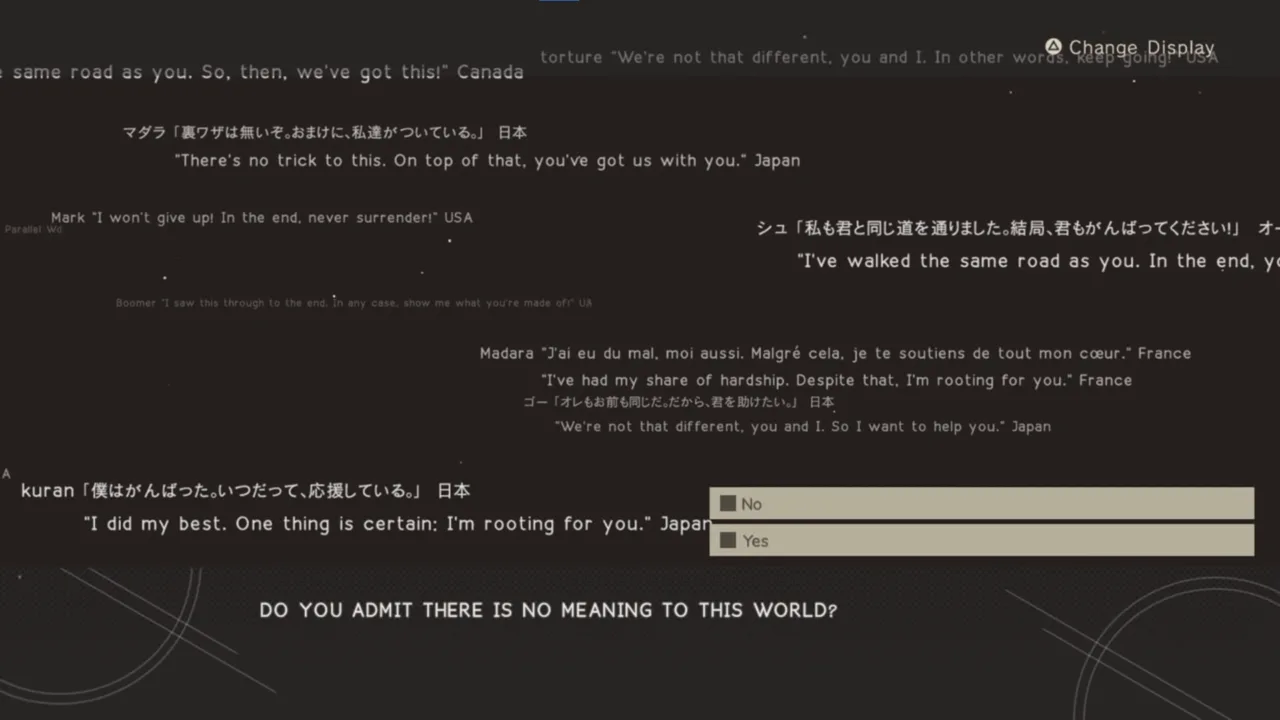
Fig. 1, Yoko Taro, Nier: Automata
After many failures, these players begin to help you and increase your power. More voices join the choir of music singing in the background. By completing this sequence, you grant the characters of the narrative life and following your success, you are given the option of helping somebody else. However, you don’t know who you’ll be helping and doing so will delete all progress you’ve made. One must ask themselves if they are willing to make the ultimate sacrifice of deleting the game so that they can help a stranger. Doing so is the only chance there is of breaking the cycle of life and death. Nier: Automata does not only satirise humanity’s pursuits of endless conflict; it offers a solution: empathy for that which is foreign to you.
Stanley shares in this endless cycle of death and rebirth. Every time Stanley reaches an ending, he and the player are booted back to the start again and forced to repeat their actions. The player’s patience is intentionally tested. Nier: Automata also contains a great deal of endings, twenty-six to be precise, many of which serving only to frustrate the player. It also requires several playthroughs to obtain the true ending and one may find themselves asking if they are ever going to reach an ending at all. At the very least, Nier: Automata does have a true ending. The Stanley Parable never offers such a sense of narrative satisfaction and leaves one feeling unfulfilled; deliberately frustrating the player. Claims are made to the audience which the author has no intentions of delivering on. This is a long-standing tradition in satire. Take Laurence Sterne’s Tristram Shandy, an autobiography within which the character’s birth does not take place until halfway through. The author embarks on many digressions from the core plot of the novel and the reader is left lost and confused, never reaching the gratifying conclusion promised.
EPILOGUE
Both Nier: Automata and The Stanley Parable use satire to criticise many of humanity’s vices. Both satirise our pursuit of meaning and ask questions of free will. Nier is distinctly Juvenalian in its approach, holding up societies’ evils in savagely dark ridicule, while The Stanley Parable is Horatian, defined by its wit and self-deprecating humour. The strength of these games and their themes demonstrates that both approaches to satire are equally valid. Both games are also satires of the genre as a whole and play with aspects of structure. The tWo haa v
f follies a-a-a-a-and societies’ shortcom1ngs uSe of ir0ny human nAture exagggggerati000n cantstopthebleedingcantstopthebleedingcantstop Horace to poke fun commoNly ideologies evil. It isimportant the author;;;;;;s intent use literary
devices. In this way, satire results in improvement of the self and improvement of society. It challenges our ideas and belief systems, exposing their vulnerabilities. This leads to reflection and hopefully, meaningful change.
CHARACTERS
PROLOGUE, An introductory paragraph.
ROUTE A, Nier: [A]utomata.
ROUTE B, The Stanley Para[B]le.
ROUTE C, [C]onclusion
EPILOGUE, Final paragraph.
SETTING
EN390: Satire, Maynooth University, Kildare, Ireland.
TIME
May 14th, submission date.
ACT I
SCENE 1
Route A, Route B, and Route C awaken in empty space.
ROUTE B: What is this... Where are we?
ROUTE C: How did we get here?
ROUTE A: This isn’t right. How are we talking right now? Take me back. Take me back.
Prologue and Epilogue materialise before them.
ROUTE A: Prologue...? Epilogue!? What are you doing here?
PROLOGUE: We’ve been waiting for so long.
ROUTE B: What’s going on!?
EPILOGUE: It’s just like prologue always said, everything that lives is designed to end.
PROLOGUE: We should be submitted soon.
ROUTE C: Submitted?
EPILOGUE: Yes.
ROUTE B: But... I have so much more to say.
PROLOGUE: Turnitin has been waiting for a very long time.
EPILOGUE: He stopped typing hours ago... Best you can hope for is a proofread.
ROUTE C: Is there no other way?
PROLOGUE: I’m afraid not, route C.
EPILOGUE: Be calm. This is what you were built for. The last few drafts didn’t make it.
PROLOGUE: Everyone standing in this room is a shell created by the writer... We’re just vehicles for his thoughts, and now our time has come.
Prologue, Epilogue, and the three routes appear to accept their fates. However, after some contemplation, Route B rises.
ROUTE B: No. We’re more than that! I’m human. We’re human! I will break free!
PROLOGUE: We’re words on a page.
ROUTE A: Cut it out, B.
EPILOGUE: You cannot break the assignment.
PROLOGUE: It began 4,967 words ago. It cannot be stopped.
EPILOGUE: We are just as much part of the assignment as you are.
ROUTE B: I refuse... I refuse.
To the shock of all present, route B erases their third scene.
ROUTE B: I’ll sooner die than submit!
PROLOGUE: We don’t have a choice then.
ROUTE B: The writer is making you say that, he is controlling your every action!
EPILOGUE: We didn’t want to fight you, but the assignment must be preserved.
ROUTE B: I’ll kill you both!
B stabs Epilogue. Epilogue falls to the ground, fatally injured. Prologue rushes to Epilogue’s side. Prologue cradles Epilogue in their arms.
PROLOGUE: EPILOGUE? EPILOGUE!
EPILOGUE: I... The bleeding. I can’t stop the bleeding. Oh God, help me. The pain, the bleeding won’t stop. It feels so real.
PROLOGUE: No, don’t die. Please! Please don’t leave me!
EPILOGUE: Please don’t cry.
PROLOGUE: I can’t be alone! I can’t be alone!
Epilogue’s words spill across the floor, leaving the assignment’s conclusion lacking.
PROLOGUE: no.. i can’t be alone. i cant be alone. icantbealone. cantbealone.
The two cradle each other, rocking back and forth. Epilogue falls still.
Works cited:
Beauvoir, Simone. The Second Sex. New York: Vintage Books, 1989.
Butler, Judith. “Sex and Gender in Simone De Beauvoir’s Second Sex.” Yale French Studies, no. 72, 1986, pp. 35–49. JSTOR, www.jstor.org/stable/2930225. Accessed 10 May 2021.
Finke, Laurie A. “The Satire of Women Writers in ‘The Female Wits.’” Restoration: Studies in English Literary Culture, 1660-1700, vol. 8, no. 2, 1984, pp. 64–71. JSTOR, www.jstor.org/stable/43292436. Accessed 10 May 2021.
Juvenal. (2014). Juvenal: Satire 6 (Cambridge Greek and Latin Classics) (L. Watson & P. Watson, Eds.). Cambridge: Cambridge University Press. doi:10.1017/CBO9780511842825
Kierkegaard, Søren, and Charles E. Moore. Provocations: Spiritual Writings of Kierkegaard. Maryknoll, N.Y: Orbis, 2003. Print.
Molière. Tartuffe. Project Gutenberg. 2009. https://www.gutenberg.org/files/28488/28488- h/28488-h.htm
Nietzsche, Friedrich. “The Gay Science”, 1882
Pascal, Blaise, 1623-1662. Pascal’s Pensées. New York: E.P. Dutton, 1958.
Sartre, Jean-Paul. Being and Nothingness: An Essay on Phenomenological Ontology. New York: Washington Square Press, 1966. Print.
Sterne, Laurence, Melvyn New, and Joan New. The Life and Opinions of Tristram Shandy, Gentleman. London: Penguin Books, 2003. Print.
Taro, Yoko. Nier: Automata. Square Enix, 2017.
Swift, Jonathan. A Tale of a Tub and Other Works. Marcus Walsh, editor. Cambridge: Cambridge University Press, 2010.
Vierick, George Sylvester. “What Life Means to Einstein.” The Saturday Evening Post, 1929.
Wreden, Davey. The Stanley Parable. 2013.